Monday, February 22, 2016

Faith

Jonathan and I took a weekend trip to Kandy last week, a Valentine's day present to ourselves. Kandy is a beautiful city – the town pools around a lake in a valley ringed with green cloud-fringed hills. Strolling around the lake dotted with lovers (discretely hidden behind umbrellas) felt romantic indeed. Still, the prevalence of the Temples and their weight on the psyche of the town made it a funny choice for a romantic getaway. The temples themselves featured signs depicting a man and woman canoodling with strict lines going through it. Clearly fighting back against young Sri Lankan's tendency to use temples as a date site.
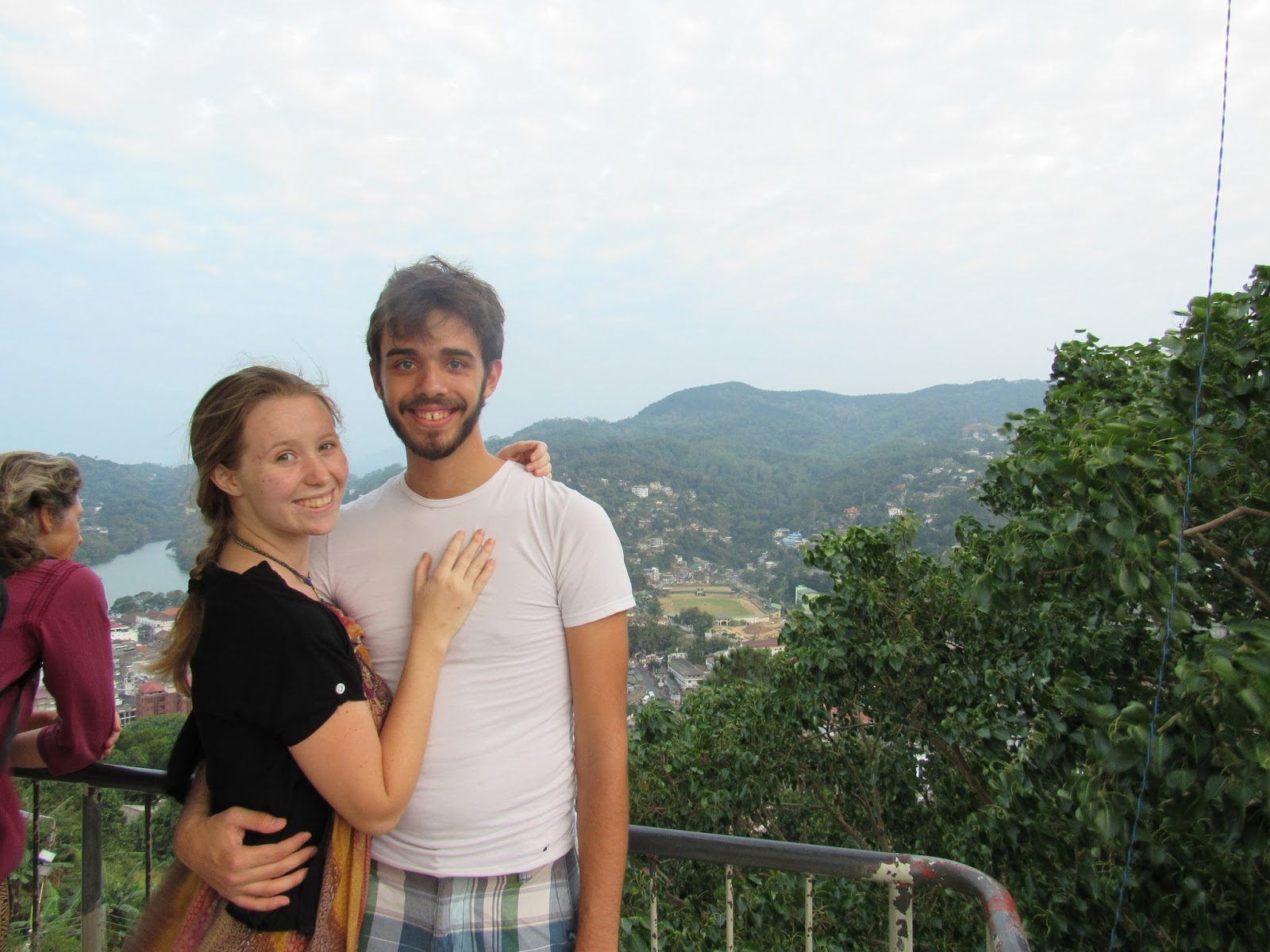
Jonathan and I... on a date at a temple 

The 80 foot White Buddha who overlooks Kandy

All the Temple visiting finally pushed me to write something I've been stewing over for a long time: faith in Sri Lanka. This is really just a collection of observations, not a well thought out or researched piece. But faith here is impossible not to observe. It is not separate from daily life as it is in the West but a part of it – from the Gods smiling down from behind restaurant counters, to the dashboard Buddhas on tuktuks, to how people on the bus stand (or at least raise their butts of the seat a few inches) when driving past a temple. Daily life is infused with faith. And faith, too, is infused with life. Today at the temple a rooster hopped and pecked across the shine, while dogs dozed in the shade of the Bo tree. To be sacred here does not mean to be closed – it means openess. That all life, nature too, has something holy about it.

Kandyan rooster investigates the Bo tree temple

From the surface Sri Lanka might seem a place of astonishing religious tolerance and diversity. If I didn't know how the war tore the country apart on Hindu and Buddhist lines I would never guess it from Colombo. A block from my apartment a tiny Buddhist temple shares a wall with a one room Hindu temple, all acrros the street from the local Mosque. I was surprised to find Parvati and Vishnu (Hindu Gods) adorning the same bus decals as Buddha, until a friend explained to me that these 'Hindu' Gods exist in Buddhist cosmology too, as powerful beings that have not attained enlightenment. Someone else told me that for the Sri Lankans, the Buddha is your spiritual teacher and adviser but it is the Gods you pray to for intercession. Want to pass your A level exams? You pray to the Gods, who are more involved in such worldly things than Buddha.

So I was surprised to find such overlap between faiths which have been at loggerheads for decades here. For reference, on Independence Day last week the national anthem was sung in both Tamil and Sinhala (the Hindu minority and the Buddhist majority languages) for the first time ever. Even this small gesture of reconciliation had some radical Buddhist politicians threatening to commit suicide, though unfortunately they seem to have not carried out their threats. Sri Lanka is home to what might seem an oxymoron: fanatic Buddhism. As the country limps towards reconciliation and equitable development under the new regime, to the careful observer, there is backlash. In the last few weeks there has been a sudden change in the Tuktuk decals I usually love, which often have stickers of the driver's favorite movie or words of wisdom such as 'Save your money'. Recently though, a sticker in Sinhala reading 'Sinha-le', meaning Sinhalese blood, has appeared on Tuktuks, and now even buses and tshirts. This is a reference to Sinhalese Buddhist identity, which might not quite be a threat in itself, but has some parallels to wearing a 'white pride' shirt in the US. Even more concerning, the slogan has been spray painted on some Muslim family's homes. Meanwhile, the leaders of one of the main Buddhist sects is in jail for calling for the death of a war widow. In Sri Lanka you can see the depth of corruption that any religion is capable one – when a Buddhist whose first tenet is to harm none, encourages his followers to kill an innocent woman.

But of course, like any 'religious conflict' this one is about more than faith. It is about ethnicity, language, distribution of resources, jobs, and history all play a role in a conflict under which religion is sometimes the banner. Indeed, if Sri Lanka moves away from Sinhala language use in the official sector, the most likely direction would be towards English, a move which will most benefit the English speaking elite regardless of their religion.


An observer for three months now, I see a lot of reason for hope. I see development and resources slowly leaking into the bombed out Tamil North, and military occupation slowly draining out of it. I see constant reason for optimism in the intelligence and enthusiasm of the young people I work with, at CEPA and in my class. I see the kleptocratic previous dynasty being dismantled, and protections created to protect the country from it happening again. I see a country full of people who feed stray dogs and buy rice packets for birds, who invest heavily in the education and happiness of their children. When I go to temples and see young couples holding hands or parents holding their children up see the Buddha, I want to say faith is a reason for hope here too. But I don't really know.  

One of my favorite temples in Colombo. It seems to me a focal point of the coexistence of the ancient and the modern in Sri Lanka. 

Thursday, February 11, 2016

The Student Teacher

My apologies for a long silence. I have at last begun working in earnest, and so have much less energy at the end of the day for writing and thinking than I used to. Will try to get back into the habit of posting!

Teaching began with my ultimate nightmare. I had been waiting for weeks to hear from the Arts Department about when I would start teaching, so when walking home from my internship I got a call from the University asking me if I could meet in 20 minutes to discuss my class, I was delighted and went straight there. The professor in charge of my class greeted me with bright smile and said 'Hello! Your students are waiting!' I explained that I didn't know I was teaching today, so didn't have a lesson prepared and couldn't teach. He assured me that was ok, and that I should come teach anyway. So, during the three minute walk to my classroom I frantically made up some discussion questions, and bumbled through half an hour of awkward question and answer with my students, hoping the heat in the room masked my nervous sweating.

To their credit, my students seem to have thoroughly forgiven me for such a rough beginning. I teach three English classes now. Two with Arts student (Arts as in humanities, not fine arts), and one with Sciences students. I love teaching – to me it is a balance of play and performance. Being interesting enough to keep them engaged while I talk, but more importantly, to keep them talking. The more I teach, the more I realize it is the job of the teacher to ask questions, not provide answers. We play games. We write stories. We use new grammar concepts to imagine the distant future, or plan the ultimate Valentine's day date. My students are delightful. They are willing to play and take risks, and when they see me outside of class they greet me with huge smiles, and come up to talk.

While I have definitely improved my teaching since that first class, the sweating remains a constant. I sweat through my clothes in the first 5 minutes of the unairconditioned class. Even the students occasionally delicately dab at themselves with handkerchiefs, and you know if the Sri Lanks are sweating, it is hot indeed. On breaks, I shiver damply in the air conditioned teachers lounge. When I get back home, my dear partner Jonathan hugs me at arm's length and steers me directly into the shower.

I am learning a lot about Sri Lanka through my students. When I walk from the Arts Faculty to the Science Faculty it is like crossing into a different world – my students are vastly different in their levels of English and their cultural backgrounds. Somehow they even look different. I am in the slightly awkward position of teaching students who are uniformly my age or older – but in the arts faculty I feel like I am teaching children. I would peg most of my students as being in their mid teens, while in the Sciences I am keenly aware of my younger age. My arts class, as one might fear, is made up of 90% girls, while in my science class the gender ratio is reversed. I initially wondered if the difference in confidence between the classes came from Sri Lankan gender roles, but there is more to it than that. The few girls in the Sciences class move with a languid confidence that matches their male peers, and if forced to guess their age from afar I would do so with a lot more accuracy than I would for my girls in the Arts.

Through my students, I believe I am seeing class differentials in Sri Lanka. STEM subjects are taught in English here, so my Sciences students are quite proficient. They are looking for practice with a native speaker, and work related vocabulary to use in the job hunts they are about to embark on. My arts students on the other hand are taught in Sinhala, and, in the beginning anyway, would blush and look away in response to simple questions like how was their weekend. When I ask about their families they talk about farmer fathers and housewife mothers, and homes far away. They want to be teachers. My Sciences 'kids' (such as they are) grew up close to Colombo, if not within it, many of them I think speaking English with their families. They will be managers and engineers, and many will seek jobs or graduate education abroad. I wonder how possible it is for a bright rural kid with low English background to study Sciences at the University of Colombo. The subject alone is difficult enough, but to study it in a language you barely speak seems almost impossible. Many of the privileged Sri Lankans I met back in the US spoke of the days when English was a Lingua franca with great nostalgia. They told me you didn't know if someone was Sinhalese or Tamil back then – everyone spoke English. And perhaps it is true you couldn't know someone's ethnicity from language, but I think you did know their Class. And this distinction of class between the English speaking and the non-English speaking world in Sri Lanka I think holds true today.


(Some unrelated good news for anyone who hasn't heard. I was accepted into New York University's Master of Social Work program last week! I even got a decent scholarship, so I should be able to afford it with only somewhat crippling debt. I'm still waiting to hear from Columbia University, but I'm quite excited to know that I'll be living in New York next year!)  

Monday, January 18, 2016

Reading around the world: Mali, and the richest man to ever live

Bienvenue au Mali!

 Mansa Musa 

Following a trend of overlooked historical figures, this week I learned the story of the wealthiest man to ever live. I read "Mansa Musa and the Empire of Mali" about the emperor of the Malian empire at it's height in the early 1300s – an empire whose riches in gold and salt made him a man worth $400 Billion in today's money. Musa's wealth allowed him to carry out the greatest Hajj in history, destabilize an entire economy by his personal spending, and build a river to a desert. Even the story of his ascendance to the Malian throne is a remarkable one. Musa's uncle left the empire in his nephew's care when he set out to explore the ocean to the West of them, determined to find whatever lands lay beyond it or end of the world. While it is not confirmed, some historians believe Musa's uncle successfully reached South America hundreds of years before Christopher Columbus. Wherever his adventures brought him, he never returned, and Musa remained king for the rest of his life.


The Malian empire at its height

What Mansa Musa is most remembered for is his elaborate Hajj, the journey to Mecca that under the 5 pillars of Islam all Muslims who are able must complete at least once in their lives. Musa was not one to do things by halves. Not only did he make the journey across the continent of Africa, he brought a moving city of 60,000 people with him – family members, slaves, courtiers, powerful families who might attempt to usurp his throne in his absence, and thousands of ordinary people who would never again have a chance to reach the holy city. The caravan included 80 camels carrying between 50 and 200 pounds of gold dust each, which Musa gave out as alms to the poor he encountered along his journey.

Musa's route to Mecca 

This reckless spending did not go without consequence. When he stopped in Cairo to restock his mobile city, he spent so much money the markets flooded with gold and inflation destabilized the Egyptian economy for 12 years. On his return through Cairo he realized his mistake and borrowed vast amounts of gold at high interest to balance out the damage he had done. On the way home Musa also managed perhaps one of the grandest gestures of love in history. One of his wives was miserable after months of traveling through the desert, filthy from the constant gritty wind and unable to sleep. So one night while she and her ladies rested Musa organized thousands of people to dig a deep channel in the desert sand and line it with rocks, and then diverted water from an oasis to fill the artificial river. Musa left Mali a unique and beautiful architectural heritage, and many Mosques are still leftover from Musa's time. (He is rumored to have had a new mosque built every Friday.)

A Mosque commissioned by Mansa Musa 

Another example of beautiful Malian architecture 

Mali today is far from its glittering heritage. One of the poorest countries in the world, the economy has been crippled by cotton subsidies in wealthy countries which make it impossible for them to compete on an international market. A civil war was recently ended with French intervention, and the country currently struggles with terrorism and separatist movements. But despite this, Mali has a flourishing democracy and a vibrant musical scene which I have enjoyed exploring this week. You can check out some contemporary and classic musical stars here!

Salif Keita - one of Mali's greatest stars 


Tata Pound - a contemporary rap musician who uses his music to call for political reform and democracy 


I also tried Malian food! I tried this recipe – which I heartily recommend. I couldn't find plantains so I substituted bananas which made it sweeter, but all the more delicious! The recipe is below. 


Plantain and Coconut Stew
From The Soul of a New Cuisine: A Discovery of the Foods and Flavors of Africa, by Marcus Samuelsson
Serves 4-6

Ingredients
1 medium Spanish onion, roughly chopped
1 cup coconut milk
the juice of 2 limes
2 Tablespoons white wine vinegar
½ cup peanut or canola oil
5 yellow plantains, peeled, quartered and cut into 1 inch pieces
2 teaspoons chopped cilantro
½ teaspoon ground ginger
½ teaspoon salt
Freshly ground pepper


Combine the onion, chilies, coconut milk, lime juice and vinegar in a medium saucepan and bring to a simmer over low heat. Simmer for 10 minutes, then remove from heat and set aside. Heat the oil in a large frying pan over medium heat; add the plantain and fry for 1-15 minutes, turning now and then so it browns. Remove the plantain and drain on paper towel. Add the plantain, cilantro, and ginger to the coconut milk mixture, and bring to a boil. Serve immediately, with salt and pepper to taste.


Saturday, January 16, 2016

Love and Democracy

“This is a story about love, but it is also a story about democracy.”
-- Visakesa Chandrasekaram 

Yesterday we went to the Galle Literary Festival, a celebration of writers, filmmakers and intellectuals from Sri Lanka and around the world. We watched the first ever Sri Lankan gay romance movie: Frangipani, a story about a love triangle between two gay men and a woman in a rural village. It was a harsh tale of the desperation when the desire to be loved and the desire to fit in becomes incompatible. Beautiful and sad, it managed to present a tragic story without vilifying or valorizing any of the characters: deeply flawed and deeply human.


The context of the film is perhaps as interesting as the film itself. In Sri Lanka, anti-sodomy laws are still on the books. However, this is rarely enforced because conviction requires three witnesses, and it would have to be some unusual sodomy indeed to have been directly observed by so many. What this does mean however, is that police have a scare tactic to use against any suspected homosexual who crosses their path. People are frequently arrested on Friday nights, leaving them to wait in jail over the weekend until judges comes in on Monday to throw out the case. It is a delicate topic. Colombo has a yearly pride festival in June which I can't wait to take part in. The intellectual westernized elite has begun to accept homosexuality as it is understood in the West, as demonstrated by accepting a gay film into the largest festival in the country. The quote which begins this blog is how the director introduces the film to a Sri Lankan audience, appealing to both emotions and to the desire to be a Western and egalitarian society. 


However, it may be this westernized understanding which makes life impossible for people like the protagonists in the film, who come from rural and deeply religious backgrounds. My friend Kenneth is researching LGBTQ Health in Sri Lanka for his Fulbright, and this is what he has been able to find out so far. Like everywhere else, homosexuality has existed in Sri Lanka for a long time. Up until a movement towards westernization in 70s, many gay men had the male equivalent of mistress alongside their wife, something not quite talked about, but not quite reviled. Not until the import of the idea of 'Gay' as a fixed and constant identity arrived from the West was homosexuality officially scorned. Now as westernization infiltrates more fully into the culture, perhaps it will become more acceptable. Perhaps not. I think it will depend largely on the poor majority's relationship to the upper class, and to the Western power which it represents.


This is a relationship I am not sure the Galle Literary festival bodes well for. A day ticket cost 3500 Sri Lanka Rupees (around $25), more than a month of poverty-level wages. While all the events I attended yesterday were free, they were clearly by and for the elite and international crowd – and designed to be comfortable. A talk on the Muslim minority included no mention of the oppression they have received at the hands of both the Tamil and the Singhalese. The festival was attended by the Colombo elite, just shifted South a couple hundred kilometers. I ran into people from my work, from Fulbright, from the art community, even the Prime Minister was there. A part of me is delighted to see the vast intellectual power and creativity in Sri Lanka celebrated on an internationally known platform. Truly, the intellect in this country floors me. I feel dwarfed by my co-workers at CEPA, most of whom have PHDs, and are all experts in their fields. I am also awed by the diversity of talent here – the man who directed Frangipani is also an internationally recognized human rights lawyer who fights torture in Sri Lanka's prisons. The woman who runs Fulbright is also an award winning poet and journalist. It is wonderful to see such talent recognized. And yet, the festival did nothing to assuage the sense of foreboding I have that this recognition, rather than uplifting Sri Lanka as a whole, may further divide it.  


Tuesday, January 12, 2016

Reading Around the world: Botswana

Welcome to Botswana!


This week begins a dive into Africa. As someone who occasionally describes myself as an Africanist, I have struggled a lot with combating the hegemonic invisibility of the continent to the western gaze. How can you study the tragedies and problems of a place without reducing it to its darkest moments? How can I bring back knowledge of a complicated and diverse place to my country, which often views 'Africa' as a remnant of a past the rest of the world has mercifully left behind? How to capture the delicate balance of progress and tradition, boundless hope and crushing despair I have encountered in my travels? How to explain the complexity of reality?

Botswana's capitol city: Gaborone 

A Botswanan Landscape 

Botswana, in my brief exploration of it, is a great example of this complexity. It is a country known for two things: disease and diamonds. At one point it held the world's highest rate of diamond production and percentage of the population with HIV – 37.9% of the population. This is almost impossible for me to imagine. What does having almost half the country ill with a potentially deadly disease really mean? It means a life expectancy of 46 years. It means every weekend had a funeral. It means a country of slowly dying orphans. It means death is always close, always waiting. For the healthy it means not just a burden of burying and mourning the dead, but of caring for the ill and the dying. I try to imagine myself in this situation - how would I live my life if I knew it was unlikely I and my friends would make it 40? Would I really devote half my precious years to schooling? Unlikely. Would I be cautious in love and family, or would I throw myself into it and try to live as much as I could before I died? Would I do everything I could to prolong my life, or would on some level I decide to die with those I love?

But in this desperate situation Botswana has managed to transform their natural resources into health for their citizens. Under President Festus Mogae Diamond wealth was transformed to free HIV medication. Botswana spends the most per person on health care of any African country, and pays for 70% of this without outside aid. Mother to infant transmission dropped to 4%. Life expectancy slowly increases. The ill and dying are able to return to their lives. Between their successful fight against aids, and a relatively stable political situation since independence, Botswana is largely considered an African success story. For more on the aids epidemic in Botswana, see this NPR story.

And yet, success is always measured. While Botswana has managed a sustained multiparty democracy since independence with no coups or civil wars, an political opposition leader recently died in a suspicious car crash. Botswana has also come under fire for forcing the last remaining Basarawa Bushmen off their ancestral lands to make way for diamond mining. And the wealth of diamonds, which has staved off death for the majority, has not yet brought them wealth. While Botswana qualifies as an 'upper middle income country' it has one of the highest inequality rates in the world as diamond wealth collects in the urban upper class. Death. Wealth. Prosperity. Tradition. Modernity. Democracy. Corruption. Life. Hope. Is this Africa?

This week I read literature centered around Botswanan woman, and concerns which had little to do with death or diamonds. It was a humanizing reminder that despite these flashy issues, many the daily trouble we face around the world are the same. Unfaithful men. Raising children. How to keep a family together when work forces you apart. I read "The No. One Ladies Detective Agency" - a cute mystery novel, and a beautiful short story called “The Collector of Treasures” by Botswanan author Bessie Head. It is well worth the few minutes it will take to read it. You can read the full story here

I also tried making Botswanan cabbage! (Am I doing a culinary cabbage tour of the world? Maybe.)  You can try the recipe here!


For more on Botswana in general, as always, I recommend the BBC country profile as a good place to start. 


Monday, January 11, 2016

The Many Faces of Sri Lanka

This weekend was a tropical whirlwind – the rushing, calming, exhilarating meander of Sri Lanka. We become caught current with no destination, and around every corner is a surprise. There are so many worlds contained in this small island. It becomes a universe in and of itself.

We went to Matara, a southern beach town, to visit two Fulbrighters teaching at a secondary school there. We become tourists as soon as we step off the bus – sudden marks for touts and tuktuk drivers. Friendly, but with that hint of aggression you always find in a place over-saturated with badly behaved foreigners. We play on the beach, exultant in sun and waves and hidden coves that look almost prehistoric. Perfect, until you get close enough to see the human refuse scattering the shore with plastic bottles and glass. And yet, it is something of a earthly paradise still. I scramble through rocks and tidepools, fascinated by the dance of life among the waves as crabs scuttle and hop between rocks and tiny fish dart. We find a fish who must have come to land millions of years ago and decided it had enough of evolution. It clung to vertical rocks with no visible limbs or appendages and hopped from crevice to crevice by thrashing its tail. It is a place which seems almost resistant to time.
Matara beach 


The strange and mysterious land fish 

One of many wonderful crabs 

We also visit a temple on a tiny island perched at the edge of the shore. The temple climbs the island like a vine, shrines connected by thin curving stairs up and up until you reach the sun-drenched top, echoing in the crash of waves. A kind of sacred silence there, even through the mummer of groups of friends, or couples hold hands and lotus blossoms, or the families holding their babies up to see the Buddha. We sit and listen to the crash of waves and the sound becomes almost sanctified,  a mantra or a prayer.


Colombo, then seems like a different world when we returned yesterday. The creaking rush of streets overfilled, clamor of smells and words and the crackling blast of prayers from many loudspeakers from many faiths, all blended together with the chorus of car horns. I took to Jonathan to Pettah, the city's largest market. A maze of wants an knockoffs – need a fake Gucci man's wallet? There's a whole street line in them. Same for shoes, luggage, sari decals, party tinsel and 50 pound bags of garlic. We found the vegetable market, lush with produce far more beautiful than you could hope to find in one of the upscale grocery stores here and at half the price. We also sought out some clothes for Jonathan, a hilarious exercise in rejection. Most shop keepers gave up at the sight of us and shooed us away with a “not have big enough!”

We wandered until we came to the red mosque, an oasis in the chaos of Pettah. I sat in the courtyard and listened to the sacred quiet, a reflection of the Island Temple of Matara. The splash of men washing before prayer in the fountain. The play of light against the brilliant patterns of red and white. Something eternal in these spaces – a truth my agnostic soul delights in the struggle to reach.


Then in the evening we found yet another world of Sri Lanka. Down three increasingly dark side streets, past two groups of drunkenly helpful tuktuk drivers, up three flights of stairs and past a travel agency and firefighter supply store we stumbled into an electronic music concert. It was a celebration for a new music school, and spanned everything from ambient sounds which left the audience confused for a good ten seconds before they figured out to clap, and jazz so exciting we started dancing in our plastic seats. It was a crucible of local and international talent – an Austrian pianist who played as if every note were a piece of his soul he pulled out of his chest, a Sri Lankan drummer who brought every beat to life. Felt like a moment out of Paris or New York, but this, too is Sri Lanka. The worlds of Sri Lanka collide and I am dizzy with the joy of it.  

Saturday, January 2, 2016

A New Year, a New Country, an Old Love

This new years I begin a new chapter of my new life. Jonathan, my partner of three years, and I will be living together for the rest of my time in Sri Lanka! This year begins like a gift. It is surreal, to have a life this luxurious, in a place this beautiful and still be with one of the people I love most. While I teach and work for CEPA Jonathan will have time to pursue his passion – music. Somehow we get to have the work we love the most and each other too. Jonathan will also work on visual coding skills to be able to pursue more specialized jobs in New York City, our probable next home.

Jonathan at our favorite local coffee shop - Hansa coffee! 


Sri Lanka continues to be good to me. We moved out of our Fulbright mansion in the suburbs this week. I found us a beautiful white apartment 15 minute walk from both my jobs in Colombo seven, a neighborhood dotted with embassies and overhung with great trees and lush gardens. We are a lazy walk from anything we could need – from cheep rice and curry to Japanese fusion restaurants to art galleries to gyms and bars. The city grows calmer here, away from the frenetic jungle of vibrant signs and pileup of shops and human life. It is a privileged area – I am grateful to live here and have this quiet haven in a chaotic world.

Our living room 


Jonathan's studio and our guest room (come visit us!)


Our bedroom

Jonathan's arrival has also re-awoken the tourist in me. I have grown complacent in my exploring of Sri Lanka – for the last few weeks more focused on preparing to move and work than exploration. In showing Jonathan our new world I have expanded it myself. I dragged us to many of the places I have meant to go all these weeks, Jonathan bleary with jet lag but stoic and excited in the face of so much new to see. He has also started a blog – for his thoughts on Sri Lanka look here! I delight in having a partner to sift through Sri Lanka with. Every day confronts us with something delightful, something challenging, something we don't understand. We wander. We consider. We get lost. We learn. Some of our adventures in the past few days are picture below - enjoy! 

The National Museum 

Home to dusty ancient treasures houses in a crumbling colonial exterior. This is the oldest Sri Lankan book, a history written on palm fronds over a thousand years ago. 


Beautiful Colonial architecture which contrasts oddly with the massive tropical trees surrounding it. 


Vigra Pilyar Kovil 

This Hindu temple resembles a mountain of deities reaching up to the heavens. A cacauphony of carve gods and flowers, living birds an even tiny trees growing up the nooks in the statues. 


The technicolored inside of the temple, lined with fantastic creatures. 

Kelenya Temple 
This site was consecrated in 500 BCE after the Buddha's arrival to arbitrate a conflict between two Sri Lankan kings. Today the temple is enmeshed in intricate carvings, painted floor to ceiling on the inside with stories of the Buddha's life and his journey here. 

Offerings 

Worshipers line up to offer water to the Bo tree, brought by the Buddha. 

Reaching to touch the daily offering of food for the Buddha 

The stupa outside the temple