Tuesday, April 19, 2016

Reading around the world: Saudi Arabia

The Saudi Capitol, Riyadh

I chose Saudi Arabia not because I know nothing about it, but because what I did know invoked a very unusual reaction from me: one of intense dislike and growing prejudice. Between scraps of knowledge about the place Saudi Arabia has within Islam, most of what I knew came from anguished news articles about yet another Sri Lankan maid being sent home after her Saudi employers forced her to eat glass, cut off her hand, or attempted to stone her to death. Foreign domestic labor can be a quick rout out of poverty – at any one time about 10% of the adult population of Sri Lanka persues higher wages and opportunity outside the country. But the chance comes a huge risk to body and soul, especially in opressive societies which have no legal protections for foreign laborers. This kind of abuse isn't limited to Saudi boarders – a couple months ago the Saudi ambassador to India fled under diplomatic immunity after raping his maid. So my image of Saudi Arabia was that of an exceptionally brutal Qatar or Emirates – a country where citizens live off oil royalties and concentrate frustrated energy on oppressing women and brutalizing the household help.

A Saudi Royal Palace

So when I read 'On Saudi Arabia' I was surprised to learn that 40% of Saudis live in poverty, and 60% cannot afford to buy homes.  Religion may be the opium of the masses, but foreign labor is the opium of labor is the opium of the Saudi economy, keeping it breathing but sedated and stagnant. Social stigmas prevent Saudis from taking the jobs which are plentiful in their country – service sector and manual labor are bountiful, but filled with cheaper and more compliant Philippinos, Ethiopians and Bangladeshis. Meanwhile a decrepit, memorization based education system fails to prepare Saudis for skilled jobs, so even doctors are imported. Coveted government jobs are choked by the leviathan royal family, as each of the 7,000 Princes need an adequately ostentatious official tittle. Women meanwhile, are gradually overtaking their male peers on every level of education, but are prohibited from working almost any job by the risk of interacting with an unrelated male, a possibility made dangerous by the vigilance of religious police to seek out and punish such forbidden fraternization.

A slum in Riyadh 

Clearly, with a economy resting on a limited natural resource and capped by the largess of the vast royal family, the current state of the Saudi economy is unsustainable. Saudi Arabia is a welfare state choked by a serpentine bureaucracy and a royal family of around 30,000 members, who dispense favors, scholarships, even placement at good hospitals on a case by case basis. Saudis watch the growing divide between the royal and the common family with resentment. Karen House presents the country as wavering on the edge of a deep divide in Saudi society: reformers who demand a more equitable, modernized society which allows space for dissent, discussion, and maybe even hints of democracy. The other side seeks to solve Saudi's problems with an even further retreat into Islam, though current Saudi society is ironically far more conservative than it was 1,400 years ago during the Prophet's time. Fundamentalists conveniently ignore that Mohammed readily interacted with unrelated women, invited them into the mosques from which they are currently banned, and respected and consulted his wives.

Change in either direction is likely to throw the country into full social unrest, as it would enrage the other side of the political spectrum. The family so far has chosen to vacillate – making modernizing reforms when confident and falling back on fundamentalist Wahhabism when spooked. The play to radical Islam by the royal family is a cynical one, as wealthy Saudis frequently break the rules they publicly espouse. It has thus far maintained social cohesion and kept the devout more concerned with the afterlife than the injustices of this world. But the facade begins to crack under widening inequality and flagrant flouting of the religious commandment to live a simple life. Islam has escaped the control of the Royals – even people on government business can be harassed by the government employed religious police.

Saudi's future remains uncertain. But one thing for sure – I have significantly more empathy for the people trapped in the stagnant milieu of Saudi Arabia. The look into the country was not a pretty one, but it revealed a very human quest for agency in an oppressive and unjust society. 

For more on Saudi Arabia:
http://www.bbc.com/news/world-middle-east-14702705

Saturday, April 16, 2016

Where the wild things are

At the end of another trip, and again Sri Lanka has left me lost for words. Our last week was inspiring in a way that cannot be captured – by words or by my camera. We traveled with John and John to the most stunning natural places I have been to – Yala National park, and Ella, home of mountains, tea plantations, and waterfalls. Even without the company it would have been an incredible trip, but being able to share my beloved Sri Lanka and it's wonderful and strange idiosyncrasies with family made it perfect. We talked and drank and ATE our way across the country and gathered memories for a lifetime. Rather than try to account everything that happened day by day this blog will again be mostly photos – a tiny fraction of what I took but hopefully enough to give a taste of what we saw. 

Miracle of miracles - we were told going into the park we had a 50% chance of seeing one of the illusive leopards, and less than that of seeing elephants. Somehow, on both days we went in, we saw both creatures. Caught sight of this leopard sunning herself on a rock for just a few seconds, but it was breathtaking. 

We stumbled on a family of elephants as well - several mothers with their calves. Having got very close to domestic elephants here I didn't think it would be too exciting, but something about the animals in the wild was awe inspiring. 

Despite the majesty of these rare animals, my favorite part of the park was the rich diversity it contained. We identified over 30 species of birds, and around 20 species of reptiles and mammals. This lake held dozens of different water birds, a squadron of crocodiles in the center, and a ring of eagles and kites around the edges. 

 Peacocks were everywhere. 

I loved these little Bee-eaters -- they darted across the road like flying jewels every few minutes. 

We saw this eagle eating breakfast - if you look closely you can see the snake in her claws. 

One of my favorite sightings were these mongooses, who liked to run along the edges of the road. 

Wild pigs didn't just live in the park - they snuffled around our cabins at the resort,  and their smell was ever present. 

This large crocodile lived in a lake in the resort. Ready for leftovers! 

My favorite moment of wild-life meets hotel-life.... these black faced Langiers enjoyed drinking from the relatively safe crocodile-free pool, much to the amazement of the child behind him. 


From Yala we moved on to Ella, and stayed on a wonderful organic, local empowerment focused, tea plantation and farm. The view from our 100 year old house was amazing - we got to watch the clouds roll across the mountains every morning. 


We also hiked up Ella rock for another glimpse of the vast panorama of the valleys.

Finally, the four of us at our lovely house in Galle,where we started our trip in a house surrounded by birds and monkeys and fruit trees with a view of the sea. 

Saturday, April 2, 2016

To the End of the World

A couple of weeks ago was my favorite of my trip so far. I had the great fortune to go on an adventure with one of my best friends from University: Mari, who is now teaching English in Japan. Mari's arrival gave us an excuse to explore the mountain regions of Sri Lanka. In a life full of beautiful adventures, this was definitely one of the most beautiful. I could try to describe the awe inspiring beauty of these places, but I wouldn't do it justice. My photos can only hint at it, but they are the best rendition I can give.


This place is called World's End, because of the breath taking drop off view from the cliff

Looking out over the clouds at the end of the world 

Looking out over the valley feels like being swallowed up by the Earth 


Gorgeous, endless tea plantations in Nuwara Eliya. 

Sunset from the most beautiful train ride in my life 

At Ella Rock in Ella 

Jonathan and I in Ravana falls in Ella 

The peace of the place was quickly and adorably interrupted by the appearance of troop of young monks


Friday, April 1, 2016

The Maldives: Paradise and the Democracy that Wasn't


This week I read “The Maldives:Islamic Republic, Tropical Autocracy”, probably one of my favorite books I've read as a part of this project. Robinson's book is a beautiful reminder that no matter how small a country is (The Maldives has just 350,000 citizens), or how simplistically we imagine it, there is deep complexity and contradiction everywhere you go. 

The Maldives is so close to Sri Lanka, and so tiny, that most embassies here serve both countries. 


The Maldives is a paradox: a global gathering point for debauchery and luxury, while across a tiny strip of blue water from the resorts women are flogged, even stoned to death for pre-marital sex. Tourists drown themselves in cocktails while liquor on inhabited Islands is sold more secretively than hard drugs. Perhaps the most heartbreaking part of this, is that it almost wasn't this way. The Maldives had three years of functioning democracy, thanks to the outrage and grief of one bereaved mother. In 2008, after her son died under interrogation in a prison cell, one woman refused to follow Maldivian tradition and bury him quietly. Instead, she dragged his broken body into the central square in Male and demanded justice. After the resulting protests that erupted around the country, a 30 year dictatorship was miraculously and peacefully overthrown. Elected in his stead was Mohamed Nasheed, himself a survivor of torture under the old regime, and an enthusiastic idealistic reformer who wanted human rights, education, and a future for his country, which stares down the barrel of climate change in a way few of us can imagine. The Islands of the Maldives are barely a meter above sea level. He brilliantly leveraged Western climate change guilt into aid for his country, even conducted a cabinet meeting underwater to raise awareness of the Maldive's fate. He planned to make the Maldives a carbon neutral country, and courted investment to switch the islands to entirely solar power.

President Nasheed signing an underwater declaration  

But it was not to last. The family of the 30 year dictator was unaccustomed to living life as ordinary civilians, and Nasheed's plan to increase taxes on resorts to bring revenue from the tourist industry to actually benefit the people of the Maldives made powerful enemies. So on February 7th 2013 the Island's police force "mysteriously" rose up against him. After the forced stormed government buildings, Nasheed disappeared for several hours. When he returned, it was to announce his resignation on live television. His Vice President was sworn in within 24 hours, and an immediate turnover of government official began. The old dictator's family once again saturated government.

The capitol Island of Male 


Somehow, the international community accepted this 'power transfer' complacently. Within a few days of the coup India, Britain and America all recognized the new 'government', and failed to insist on snap elections. As human rights abuses began to spiral out of control and elections were pushed  back for months at a time for increasingly ridiculous reasons, the international community, far too late, began to sanction and speak out against the regime. The Maldives is dependent on its reputation: a few targeted travel warnings can cripple the only industry it has: tourism. But these warnings came too few and too late. The old regime's cronies bought enough support to carry them through elections, once they finally happened, emptying the country's bank accounts to do so. They now maintain popularity through a cynical manipulation of nationalism and Islamic radicalism: whipping up common Maldivians into Islamic fervor while they sneak to Colombo for drinks on the weekends. The Maldives has become the highest contributor of troops to ISIL of any country not directly involved in the conflict. A woman was recently sentenced to be stoned to death for adultery, a crime her lawmakers gladly and repeatedly commit.

Robinson's book was shot through with bewildered disgust at tourism in the Maldives. He couldn't understand how people gladly give up their savings to get sunburned on beaches where the locals neither want or respect them, and their capacity to be completely blind to the horror which takes place on the other side of paradise. I had wanted to visit the Maldives before I leave: flights from Colombo are just $70. But after this book I have no desire to go. Tourism is intentionally structured to stay in the hands of a small elite which is largely responsible for the economic and social collapse of their society, motivated only by their own greed. I will not, I will never, allow a dollar of my money to fuel their lust for power. 

For more on the Maldives I hope you will check out the Maldives Independent, the newspaper the author worked for during his four years in the Maldives. They worked hard to report fairly despite intimidation and sabotage: one of their reporters even disappeared, probably murdered. Bravery like this surely deserves a few webpage clicks. Besides, a few minutes of digging turned up this gem of an article where a Member of Parliament called women 'screaming cows', and claimed that women are the leading cause of heart attacks and strokes. Ooops. Sorry, yes, causing deadly disease is a rather embarrassing habit of mine. Called out. 

Friday, March 18, 2016

Reading Around the World - Libya: Dictatorship, self Determination, Desolation

The skyline of Tripoli 

This week I read "Sandstorm: Libya in the Time of Revolution", which follows the months of fighting around the revolution. The author conformed to the dominant western depiction of Gaddafi as devious but blundering kook, and a pervert at that. From our standpoint, he seems almost a cartoon villain, complete with a face collapsing from botox and a squad of suspiciously attractive female body guards. But in Africa, he was often thought of quite differently. Libya was quite a wealthy country – it has a lot of oil and a low population to split the proceeds. Gaddafi was generous with this wealth. He supported what he saw as social change around Africa, from the terrorist Charles Taylor in Libya to the revolution in South Africa. Nelson Mandala saw him as a great friend. When I traveled to Kampala, in Uganda, I was struck by the magnificent mosque that dominated the skyline. When I went to visit, my guide enthusiastically told me that Gaddafi had built it. The Libyan people too, benefited from this wealth. Education was universal, literacy improved, and women's status increased with their education.


Gaddafi's National Mosque I visited in Kampala. Unfortunately my pictures didn't survive the trip, so you'll just have to imagine me posing with it in a pink rhinestoned hijab. 


Gaddafi with his 'Green Book', a manifesto he wrote and mandated study of in Libya

The problem comes with absolute power. Gaddafi never took an official leadership title, claiming that “the people” lead Libya, and he was merely a guide. But an institution-less government meant there were no checks on his power. He treated governance as a playground for his family and friends. When power is based entirely upon relationships, there is no room for truth. No room for dissent. Instead, there were prisons. Dissenters were quickly hidden in these black holes, with no access to the outside world. Many died of starvation or torture. Families brought food and clothes to their loved ones week after week, only to eventually find out they had died years ago. The population was well educated, but without connections there were no jobs to be had – the government had a stranglehold on every sector of business. After 40 years, Libyans were tired. They were tired of the endless dull humiliation of unemployment. Tired of seeing their money splashed carelessly across the continent. Tired of waiting, hoping, that one day their sons and brothers and husbands would emerge from prison alive. So they began to fight. A barely armed ragtag group of untrained young men stands little chance against a national army armed with some of the most expensive weapons in the world. It looked bleak for the revolution. Until the United States began to fight on their side.

Gaddafi turned into a meme by the revolution - in this speech he claims he will hunt the rebels down 'zenga zenga', or alley by alley. This threat was transformed into a catchy dance number. 

My lifelong study of violence has, paradoxically, left me not unconditionally against violence. I believe in the potential for killing to prevent killing. I would gladly reach back in time and fire the gun that could have prevented the Rwandan genocide: it could have been done, should have been done. Even a hundred lives of the tiny elite who orchestrated the slaughter is surely worth the 80,000 who died for their hate. The problem is we can never know what would have happened had we not acted. Unspilt blood doesn't stain. So Libya emerges as a test: we fought on the side of “the people”. Did they win?

The easy answer is No. Libya dropped off the media map. I struggled to find an article on their post-Arab Spring prospects written in the past year. And perhaps this was the death of it. As Western attention faded, so did any semblance of order. Ghaddafi left a fractured country without established institutions, a country where the only people left qualified to lead had been in exile so long they barely knew Libya. The fragile interim government failed to bring the country together. Now hundreds of armed groups vie for power in the aftermath, and the Muslim Brotherhood grows in the vacuum. Gaddafi may have been a dictator. But ultimately, it seems, he was better than nothing. So should we have acted? Should we have allowed the slaughter that surely would have occurred if the US didn't act to protect the rebels? Or by preventing it did we just allow a drawn out slaughter which will consume the whole country? Libya offers the hard lesson: you cannot act without taking responsibility. Western assistance dried up with Gaddafi's death, and without this, it is little wonder the inexperienced and unprepared idealists who tried to built a functioning government from the rubble of revolution failed. We bought them a revolution. But it is the Libyan people, now, who pay the price.

Bhengazi after years of fighting 

If you are interested in learning more about post-revolution Libya, I found these articles helpful. 


Sunday, March 6, 2016

Jaffna part two: The Gods Revealed

On the train 

As we travel North the water disappears. When we leave Colombo at sunrise mist covers emerald green rice patties, a delicate rose sky reflects in pools around the crops. The air hangs heavy with water. Along the road to Jaffna the water recedes, slowly at first, but suddenly you look up and palm trees are replaced with stubby palms, and gnarled plants cling close to sandy earth. A swamp devoid of water. I sit in the door of the train and let the girtty air play across my face. Air is unfamiliar without the clinging embrace of moisture – feel alien.

Money, too, drains like water from the landscape. Houses cobbled together from sheet mettle, or half finished with one wall painted or plastered and rest crumbling and forgotten looking. We pass wells for the whole town, and NGOs advertising their landmine clearing services. Though I know all this is here, I am shocked to see it. My first tangible evidence of the war. If in Colombo war hides in the shadows, here it covers the landscape like dust. I lose count of the empty shells of houses we pass.


Jaffna is a place of picturesque destruction. From remnants of empire, to remnants of pre-war prosperity, everything seems in ruins. Even the nicest streets are pockmarked by lots empty except for collapsing concrete and the occasional cow. I am torn: do I capture the crumbling beauty in my camera, or turn away, leave the emptiness to the ghosts. How strange to find the remains of destruction and violence beautiful.


Abandoned Churches 

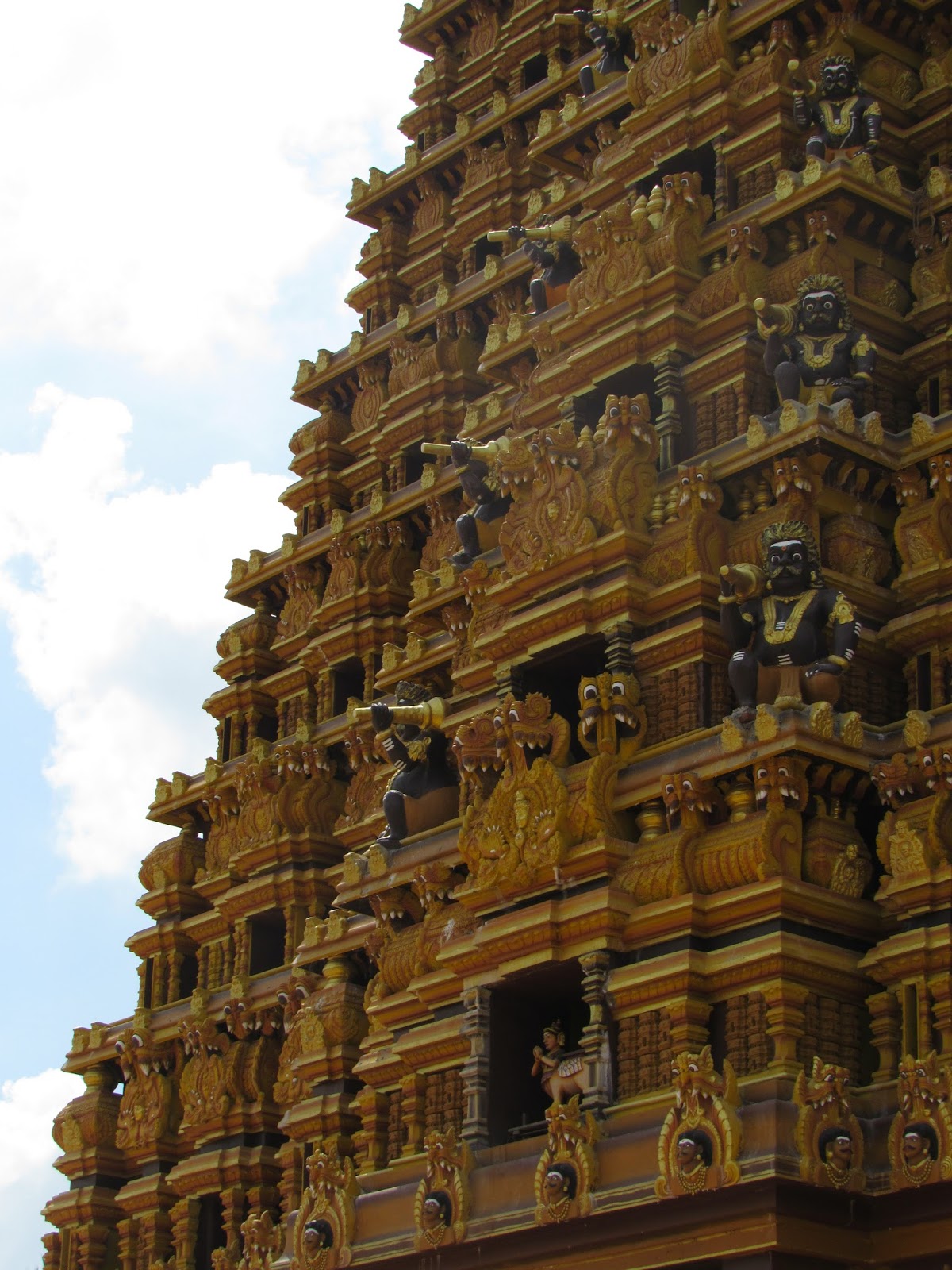
But our third day in Jaffna was one of life. We went to the Nullar Kovil Temple for a Pooja, or worship service. As we neared the temple we were greeted by a cacophony of bells, which I thought must have come from a church, but realized hung from one of the many great towers of the temple, looming in great pyramids above the white sand and alive with carved demons and grinning faces. As we drew close, the bells were replaced with drums and the winding call of a horn. The priests, shirtless and striped in holy ash, lead us with a crowd or worshipers from shrine to shrine around the vast temple. The drummer hammered a beat that the horn player wove in and out of while the priests opened door after door to reveal the God hidden behind, and offer incense. The people around us held up their hands or knelt in prayer as their favorite God was revealed. As we circled around the temple the horn player began to break away from the repetition of his song, soaring above and around and then returning to his rhythms in a way I have only one word for... it was Jazz.


A Buddhist monk once told me that sees the world as infused with kindness. That behind every object, machine, or place, is the kindness of hundreds of people who helped to create it. Kindness of those who built the building we stood in, kindness of those who made the carpets, kindness of those who changed the lightbulbs and swept the floors. In what we in the west call “self interest” and “profit motive”, he sees a sacred network of interconnected individuals working to help one another. I don't know if I can fully subscribe to this kindness theory, but it is a worldview I like to fit over my own from time to time, like tinted glasses. As I left, I realized, you can do something similar for Jaffna. You can concentrate on the shells of homes, mourn their emptiness, gnash your teeth at the slow pace of reconstruction. But, for every abandoned house, there are a dozen full ones. Jaffna was completely empty for years during the war. The residents fled to squalid camps or hid and starved in jungles. Everyone over the age of 12 remembers. But still, they come back. Open shops. Rebuild their homes. Go on dates. Love. Fight. Mourn. Have children. In Jaffna you can see tragedy in everything. Or, if you choose, a world infused with hope.


Wednesday, March 2, 2016

Jaffna Part One

Traveling is sometimes rife with the awkward and the uncomfortable, as language and cultural barriers collide head on into some terrible wreckage of social interaction. All of my experiences of this ilk in Sri Lanka, it seems, were waiting for me in Jaffna. Within 30 minutes of arriving in Jaffna someone offered me their child. Within 3 hours, I was 90% naked and dripping in oil.

After the 7 hour train ride to Jaffna Jonathan and I stumbled immediately into the nearest restaurant, one of those places that demonstrate the revitalization of the North... sort of. It was a largish place busily installing a superfluous decorative pond and concrete circles with no discernible purpose. The restaurant staff, of which there were many more than patrons, hurriedly busied themselves with not taking our order for a good 15 minutes. While we fidgeted hungrily, a man dragged his little son over to our table to look at us. While the boy eyed us with an appropriate level of sullen suspicion, his father attempted to coax him to speak to us. To fill the awkward silence, I asked how old the boy was, to which his father disconcertingly responded “Oh, do you want him?” We could think of no better response to this than nervous laughter and frantic head shaking.
Once we joined our friends Natasha and Shabia, Fulbrighters teaching in Jaffna, they mentioned they were going to get a massage at a place recommend by a neighbor. Thinking it would be nice to relax after the train, I went along. A long, confused Tuktuk ride later we pulled up outside a slightly dilapidated house with a 'Herbal Healing' sign out front. Shabia valiantly attempted to explain to our masseuses (whose English was quite limited) that we were meeting friends for dinner and would only have time for a half hour massage. Remembering the leisurely restaurant experience, I gave up on explaining time sensitivity in a small underdeveloped town of the global south, and tried to relax into the experience. I was guided behind some curtains to the massage table (literally, a table) and took off most of my clothes. The massage turned out to be more oil than massage, mostly just dripping the warm slippery stuff over my body and squelching it around. Nevertheless, I felt oddly safe with my masseuse, who was blind in one eye and blithely asked me questions in Tamil, undiscouraged by my complete inability to respond. I was just beginning to relax to the melodramatic tones of that great linguistic universal, the soap opera, which blared on the TV outside, when she flipped me over and deftly removed my bra. 

I find that in countries with strict barriers between the sexes, barriers within genders tend to break down. I reminded myself of this repeatedly as she rubbed oil into my boobs. Just when I felt the experience could hardly get weirder, she emerged from the shadows with a large plastic contraption. It was vibrating. This was liberally applied all over my body – yes – boobs too. After I had been vibrated to her satisfaction, I went to rejoin my friends, and was taken aback to discover them receiving massages a room with a coffin. Natasha sprawled on a massage table that looked suspiciously like a door. On closer inspection, I think the coffin was actually some kind of derelict massage equipment, but I'd choose the door any day.

From there we hurried to shower before joining our friends for a movie (we had given up on dinner). It took 4 shampoos to get the oil out of my hair. We did make it – just in time for the 9 pm showing, which, it turned out, started at 9:30. Tickets for the 9:30 movie, we were informed, would begin selling at 9:45. As we waited the lobby gradually filled with about half of Jaffna's male population under 40, whose universal reaction to seeing the group of us (five women and one man) was to laugh hysterically. Though I don't speak Tamil I'm pretty sure I understood their response “Women!?! But it's after dark!!!”. The guys took our brazen and shameless appearance in a movie theater after 7 pm to be clear evidence that we were some sort of prostitutes, and they passed the time by discussing various parts of our anatomies. The leer-giggling continued for one of the most uncomfortable half hours I've had in Sri Lanka, until, fuming, we finally got to into the theater.

The movie was great though. Somehow Kollywood turned medical certificate fraud into a rollicking action movie, complete with chase scenes, warnings against the terrible dangers of alcohol, and inexplicable dance numbers. The plot doesn't bear repeating, but the metaphors the romantic leads used to describe each other certainly do. I've saved my favorites for you:
“my tribe of monkeys”
“google glasses”
“like a touch screen” (sensual!) and finally,
“my jaggery paste”.

More to come on Jaffna. Later explorations of the town were a lot more contemplative and lot less absurd. But now that I've had one of those zany adventures that people turn into travel memoirs (you know, the kind which focuses a little too much on the lack of toilet paper), I feel I can't waste it.