Friday, March 18, 2016

Reading Around the World - Libya: Dictatorship, self Determination, Desolation

The skyline of Tripoli 

This week I read "Sandstorm: Libya in the Time of Revolution", which follows the months of fighting around the revolution. The author conformed to the dominant western depiction of Gaddafi as devious but blundering kook, and a pervert at that. From our standpoint, he seems almost a cartoon villain, complete with a face collapsing from botox and a squad of suspiciously attractive female body guards. But in Africa, he was often thought of quite differently. Libya was quite a wealthy country – it has a lot of oil and a low population to split the proceeds. Gaddafi was generous with this wealth. He supported what he saw as social change around Africa, from the terrorist Charles Taylor in Libya to the revolution in South Africa. Nelson Mandala saw him as a great friend. When I traveled to Kampala, in Uganda, I was struck by the magnificent mosque that dominated the skyline. When I went to visit, my guide enthusiastically told me that Gaddafi had built it. The Libyan people too, benefited from this wealth. Education was universal, literacy improved, and women's status increased with their education.


Gaddafi's National Mosque I visited in Kampala. Unfortunately my pictures didn't survive the trip, so you'll just have to imagine me posing with it in a pink rhinestoned hijab. 


Gaddafi with his 'Green Book', a manifesto he wrote and mandated study of in Libya

The problem comes with absolute power. Gaddafi never took an official leadership title, claiming that “the people” lead Libya, and he was merely a guide. But an institution-less government meant there were no checks on his power. He treated governance as a playground for his family and friends. When power is based entirely upon relationships, there is no room for truth. No room for dissent. Instead, there were prisons. Dissenters were quickly hidden in these black holes, with no access to the outside world. Many died of starvation or torture. Families brought food and clothes to their loved ones week after week, only to eventually find out they had died years ago. The population was well educated, but without connections there were no jobs to be had – the government had a stranglehold on every sector of business. After 40 years, Libyans were tired. They were tired of the endless dull humiliation of unemployment. Tired of seeing their money splashed carelessly across the continent. Tired of waiting, hoping, that one day their sons and brothers and husbands would emerge from prison alive. So they began to fight. A barely armed ragtag group of untrained young men stands little chance against a national army armed with some of the most expensive weapons in the world. It looked bleak for the revolution. Until the United States began to fight on their side.

Gaddafi turned into a meme by the revolution - in this speech he claims he will hunt the rebels down 'zenga zenga', or alley by alley. This threat was transformed into a catchy dance number. 

My lifelong study of violence has, paradoxically, left me not unconditionally against violence. I believe in the potential for killing to prevent killing. I would gladly reach back in time and fire the gun that could have prevented the Rwandan genocide: it could have been done, should have been done. Even a hundred lives of the tiny elite who orchestrated the slaughter is surely worth the 80,000 who died for their hate. The problem is we can never know what would have happened had we not acted. Unspilt blood doesn't stain. So Libya emerges as a test: we fought on the side of “the people”. Did they win?

The easy answer is No. Libya dropped off the media map. I struggled to find an article on their post-Arab Spring prospects written in the past year. And perhaps this was the death of it. As Western attention faded, so did any semblance of order. Ghaddafi left a fractured country without established institutions, a country where the only people left qualified to lead had been in exile so long they barely knew Libya. The fragile interim government failed to bring the country together. Now hundreds of armed groups vie for power in the aftermath, and the Muslim Brotherhood grows in the vacuum. Gaddafi may have been a dictator. But ultimately, it seems, he was better than nothing. So should we have acted? Should we have allowed the slaughter that surely would have occurred if the US didn't act to protect the rebels? Or by preventing it did we just allow a drawn out slaughter which will consume the whole country? Libya offers the hard lesson: you cannot act without taking responsibility. Western assistance dried up with Gaddafi's death, and without this, it is little wonder the inexperienced and unprepared idealists who tried to built a functioning government from the rubble of revolution failed. We bought them a revolution. But it is the Libyan people, now, who pay the price.

Bhengazi after years of fighting 

If you are interested in learning more about post-revolution Libya, I found these articles helpful. 


Sunday, March 6, 2016

Jaffna part two: The Gods Revealed

On the train 

As we travel North the water disappears. When we leave Colombo at sunrise mist covers emerald green rice patties, a delicate rose sky reflects in pools around the crops. The air hangs heavy with water. Along the road to Jaffna the water recedes, slowly at first, but suddenly you look up and palm trees are replaced with stubby palms, and gnarled plants cling close to sandy earth. A swamp devoid of water. I sit in the door of the train and let the girtty air play across my face. Air is unfamiliar without the clinging embrace of moisture – feel alien.

Money, too, drains like water from the landscape. Houses cobbled together from sheet mettle, or half finished with one wall painted or plastered and rest crumbling and forgotten looking. We pass wells for the whole town, and NGOs advertising their landmine clearing services. Though I know all this is here, I am shocked to see it. My first tangible evidence of the war. If in Colombo war hides in the shadows, here it covers the landscape like dust. I lose count of the empty shells of houses we pass.


Jaffna is a place of picturesque destruction. From remnants of empire, to remnants of pre-war prosperity, everything seems in ruins. Even the nicest streets are pockmarked by lots empty except for collapsing concrete and the occasional cow. I am torn: do I capture the crumbling beauty in my camera, or turn away, leave the emptiness to the ghosts. How strange to find the remains of destruction and violence beautiful.


Abandoned Churches 

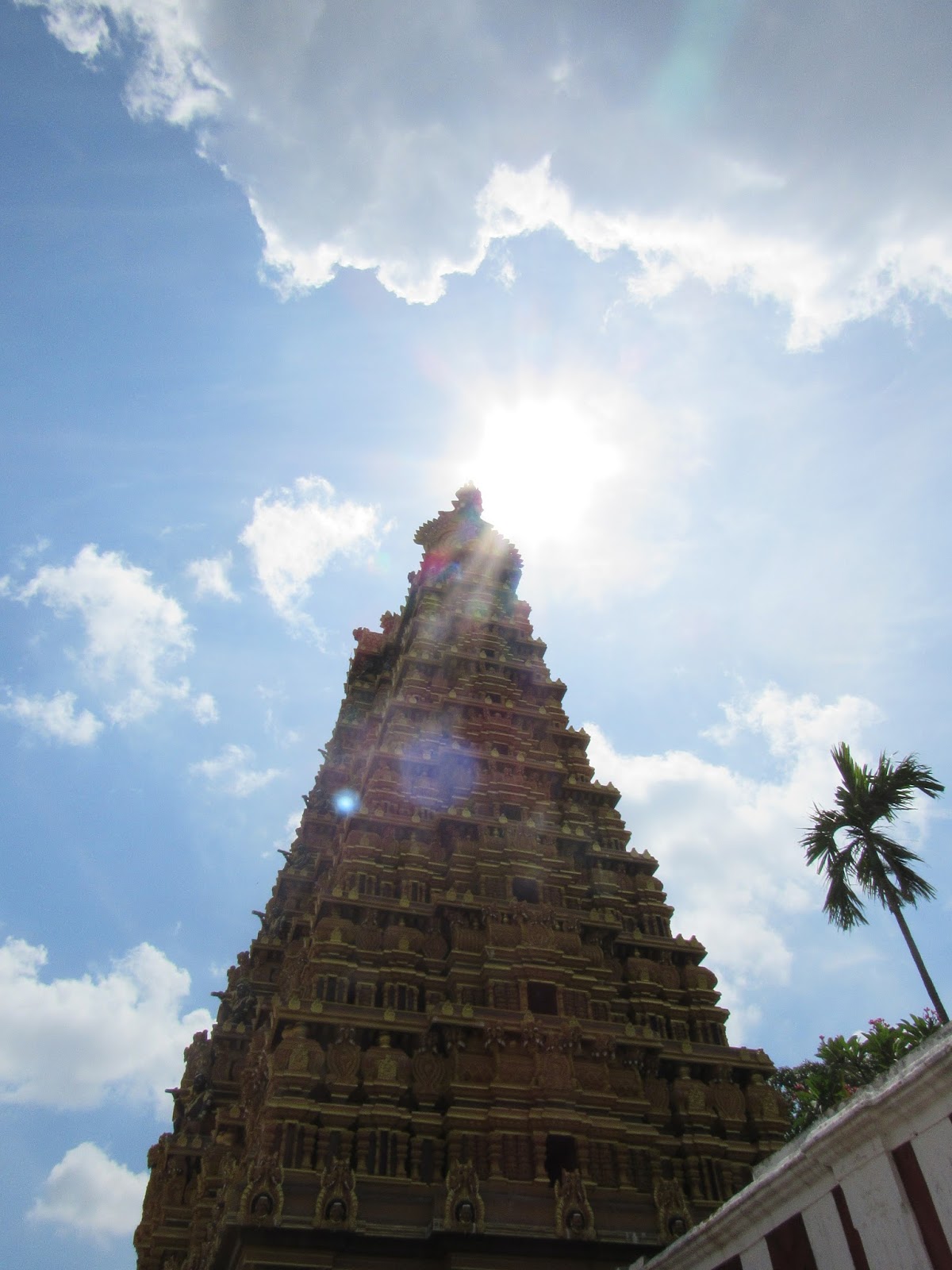
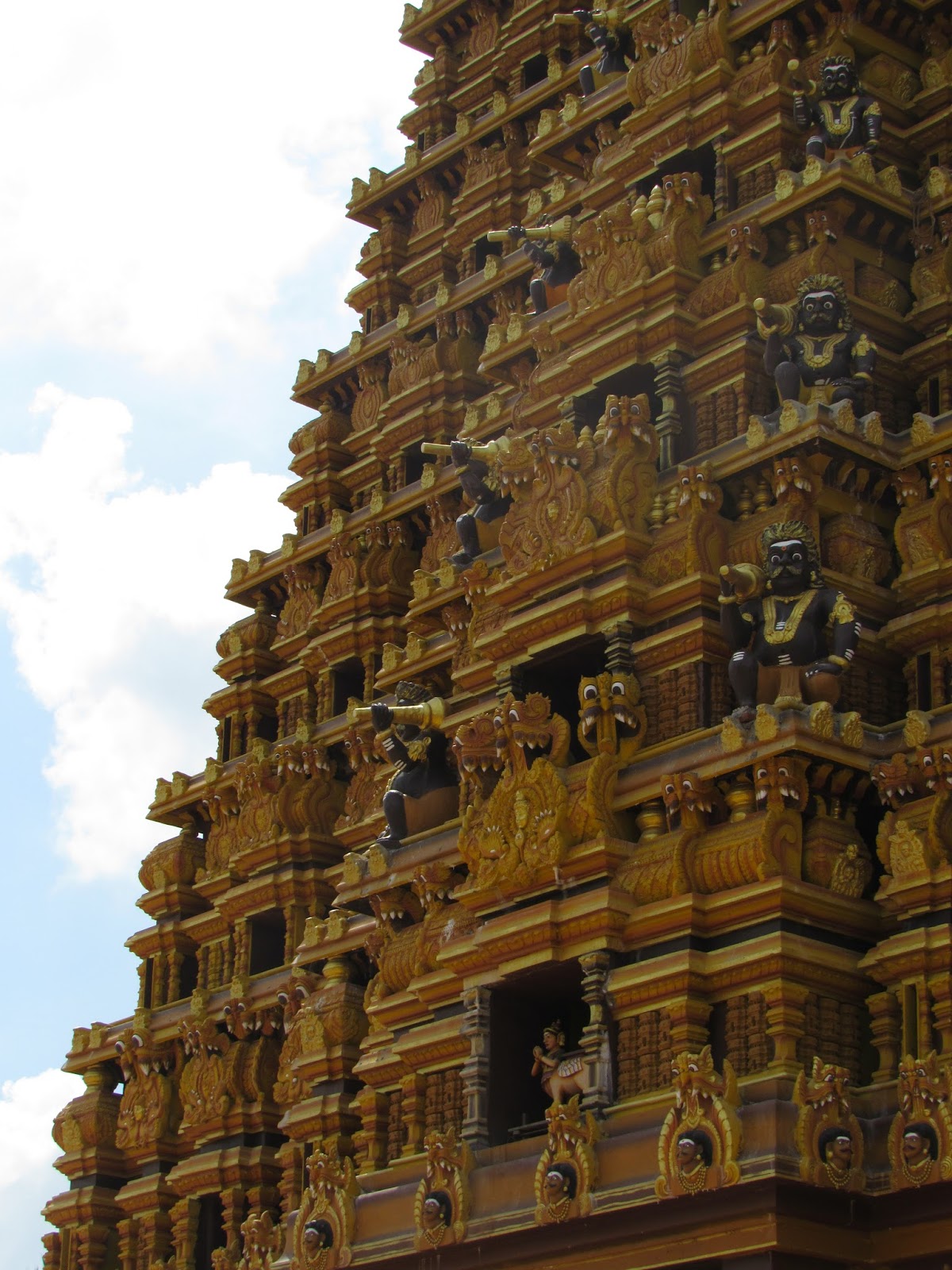
But our third day in Jaffna was one of life. We went to the Nullar Kovil Temple for a Pooja, or worship service. As we neared the temple we were greeted by a cacophony of bells, which I thought must have come from a church, but realized hung from one of the many great towers of the temple, looming in great pyramids above the white sand and alive with carved demons and grinning faces. As we drew close, the bells were replaced with drums and the winding call of a horn. The priests, shirtless and striped in holy ash, lead us with a crowd or worshipers from shrine to shrine around the vast temple. The drummer hammered a beat that the horn player wove in and out of while the priests opened door after door to reveal the God hidden behind, and offer incense. The people around us held up their hands or knelt in prayer as their favorite God was revealed. As we circled around the temple the horn player began to break away from the repetition of his song, soaring above and around and then returning to his rhythms in a way I have only one word for... it was Jazz.


A Buddhist monk once told me that sees the world as infused with kindness. That behind every object, machine, or place, is the kindness of hundreds of people who helped to create it. Kindness of those who built the building we stood in, kindness of those who made the carpets, kindness of those who changed the lightbulbs and swept the floors. In what we in the west call “self interest” and “profit motive”, he sees a sacred network of interconnected individuals working to help one another. I don't know if I can fully subscribe to this kindness theory, but it is a worldview I like to fit over my own from time to time, like tinted glasses. As I left, I realized, you can do something similar for Jaffna. You can concentrate on the shells of homes, mourn their emptiness, gnash your teeth at the slow pace of reconstruction. But, for every abandoned house, there are a dozen full ones. Jaffna was completely empty for years during the war. The residents fled to squalid camps or hid and starved in jungles. Everyone over the age of 12 remembers. But still, they come back. Open shops. Rebuild their homes. Go on dates. Love. Fight. Mourn. Have children. In Jaffna you can see tragedy in everything. Or, if you choose, a world infused with hope.


Wednesday, March 2, 2016

Jaffna Part One

Traveling is sometimes rife with the awkward and the uncomfortable, as language and cultural barriers collide head on into some terrible wreckage of social interaction. All of my experiences of this ilk in Sri Lanka, it seems, were waiting for me in Jaffna. Within 30 minutes of arriving in Jaffna someone offered me their child. Within 3 hours, I was 90% naked and dripping in oil.

After the 7 hour train ride to Jaffna Jonathan and I stumbled immediately into the nearest restaurant, one of those places that demonstrate the revitalization of the North... sort of. It was a largish place busily installing a superfluous decorative pond and concrete circles with no discernible purpose. The restaurant staff, of which there were many more than patrons, hurriedly busied themselves with not taking our order for a good 15 minutes. While we fidgeted hungrily, a man dragged his little son over to our table to look at us. While the boy eyed us with an appropriate level of sullen suspicion, his father attempted to coax him to speak to us. To fill the awkward silence, I asked how old the boy was, to which his father disconcertingly responded “Oh, do you want him?” We could think of no better response to this than nervous laughter and frantic head shaking.

Once we joined our friends Natasha and Shabia, Fulbrighters teaching in Jaffna, they mentioned they were going to get a massage at a place recommend by a neighbor. Thinking it would be nice to relax after the train, I went along. A long, confused Tuktuk ride later we pulled up outside a slightly dilapidated house with a 'Herbal Healing' sign out front. Shabia valiantly attempted to explain to our masseuses (whose English was quite limited) that we were meeting friends for dinner and would only have time for a half hour massage. Remembering the leisurely restaurant experience, I gave up on explaining time sensitivity in a small underdeveloped town of the global south, and tried to relax into the experience. I was guided behind some curtains to the massage table (literally, a table) and took off most of my clothes. The massage turned out to be more oil than massage, mostly just dripping the warm slippery stuff over my body and squelching it around. Nevertheless, I felt oddly safe with my masseuse, who was blind in one eye and blithely asked me questions in Tamil, undiscouraged by my complete inability to respond. I was just beginning to relax to the melodramatic tones of that great linguistic universal, the soap opera, which blared on the TV outside, when she flipped me over and deftly removed my bra. 

I find that in countries with strict barriers between the sexes, barriers within genders tend to break down. I reminded myself of this repeatedly as she rubbed oil into my boobs. Just when I felt the experience could hardly get weirder, she emerged from the shadows with a large plastic contraption. It was vibrating. This was liberally applied all over my body – yes – boobs too. After I had been vibrated to her satisfaction, I went to rejoin my friends, and was taken aback to discover them receiving massages a room with a coffin. Natasha sprawled on a massage table that looked suspiciously like a door. On closer inspection, I think the coffin was actually some kind of derelict massage equipment, but I'd choose the door any day.

From there we hurried to shower before joining our friends for a movie (we had given up on dinner). It took 4 shampoos to get the oil out of my hair. We did make it – just in time for the 9 pm showing, which, it turned out, started at 9:30. Tickets for the 9:30 movie, we were informed, would begin selling at 9:45. As we waited the lobby gradually filled with about half of Jaffna's male population under 40, whose universal reaction to seeing the group of us (five women and one man) was to laugh hysterically. Though I don't speak Tamil I'm pretty sure I understood their response “Women!?! But it's after dark!!!”. The guys took our brazen and shameless appearance in a movie theater after 7 pm to be clear evidence that we were some sort of prostitutes, and they passed the time by discussing various parts of our anatomies. The leer-giggling continued for one of the most uncomfortable half hours I've had in Sri Lanka, until, fuming, we finally got to into the theater.

The movie was great though. Somehow Kollywood turned medical certificate fraud into a rollicking action movie, complete with chase scenes, warnings against the terrible dangers of alcohol, and inexplicable dance numbers. The plot doesn't bear repeating, but the metaphors the romantic leads used to describe each other certainly do. I've saved my favorites for you:
“my tribe of monkeys”
“google glasses”
“like a touch screen” (sensual!) and finally,
“my jaggery paste”.

More to come on Jaffna. Later explorations of the town were a lot more contemplative and lot less absurd. But now that I've had one of those zany adventures that people turn into travel memoirs (you know, the kind which focuses a little too much on the lack of toilet paper), I feel I can't waste it.  

Monday, February 22, 2016

Faith

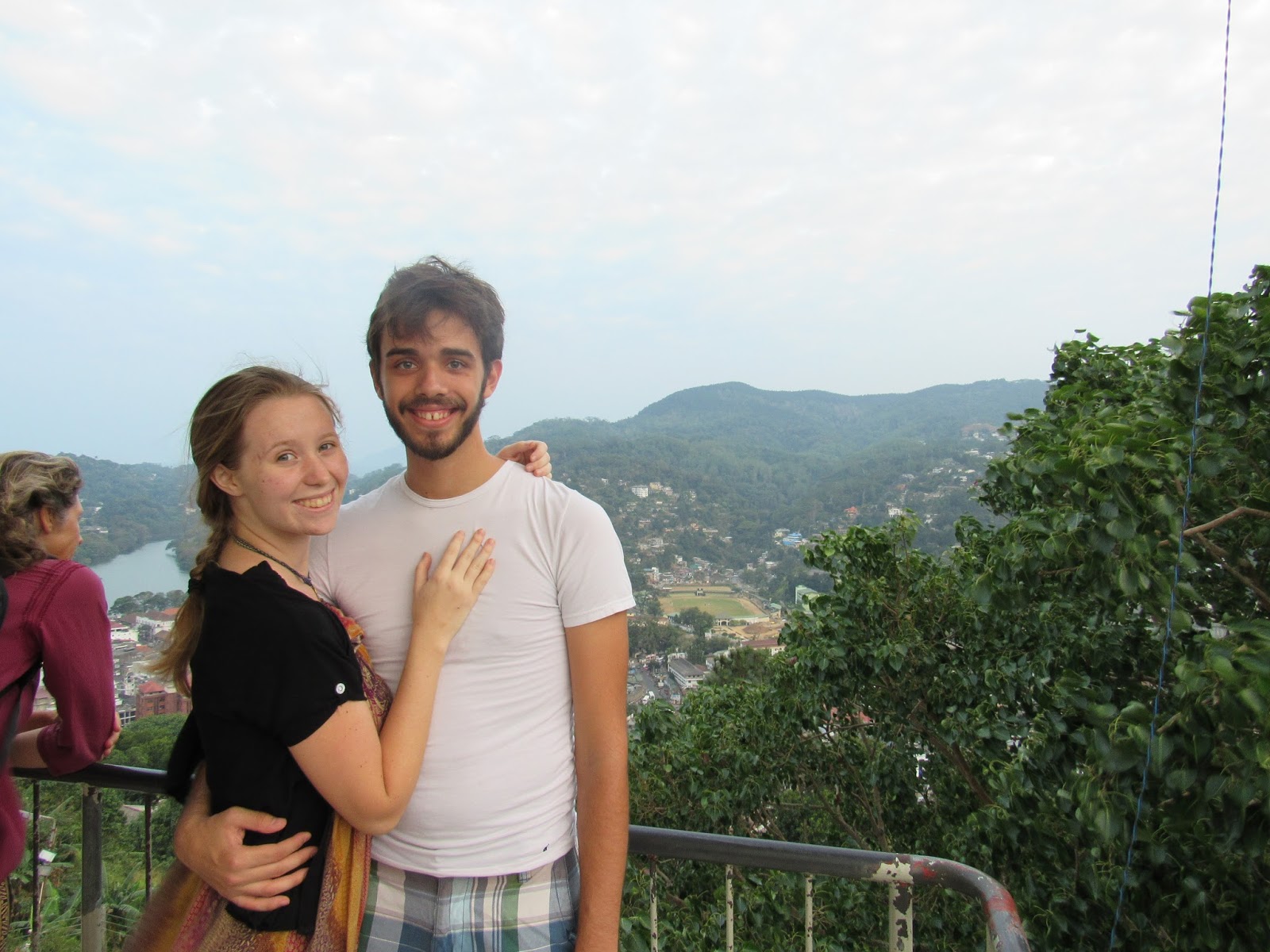
Jonathan and I took a weekend trip to Kandy last week, a Valentine's day present to ourselves. Kandy is a beautiful city – the town pools around a lake in a valley ringed with green cloud-fringed hills. Strolling around the lake dotted with lovers (discretely hidden behind umbrellas) felt romantic indeed. Still, the prevalence of the Temples and their weight on the psyche of the town made it a funny choice for a romantic getaway. The temples themselves featured signs depicting a man and woman canoodling with strict lines going through it. Clearly fighting back against young Sri Lankan's tendency to use temples as a date site.

Jonathan and I... on a date at a temple 

The 80 foot White Buddha who overlooks Kandy

All the Temple visiting finally pushed me to write something I've been stewing over for a long time: faith in Sri Lanka. This is really just a collection of observations, not a well thought out or researched piece. But faith here is impossible not to observe. It is not separate from daily life as it is in the West but a part of it – from the Gods smiling down from behind restaurant counters, to the dashboard Buddhas on tuktuks, to how people on the bus stand (or at least raise their butts of the seat a few inches) when driving past a temple. Daily life is infused with faith. And faith, too, is infused with life. Today at the temple a rooster hopped and pecked across the shine, while dogs dozed in the shade of the Bo tree. To be sacred here does not mean to be closed – it means openess. That all life, nature too, has something holy about it.

Kandyan rooster investigates the Bo tree temple

From the surface Sri Lanka might seem a place of astonishing religious tolerance and diversity. If I didn't know how the war tore the country apart on Hindu and Buddhist lines I would never guess it from Colombo. A block from my apartment a tiny Buddhist temple shares a wall with a one room Hindu temple, all acrros the street from the local Mosque. I was surprised to find Parvati and Vishnu (Hindu Gods) adorning the same bus decals as Buddha, until a friend explained to me that these 'Hindu' Gods exist in Buddhist cosmology too, as powerful beings that have not attained enlightenment. Someone else told me that for the Sri Lankans, the Buddha is your spiritual teacher and adviser but it is the Gods you pray to for intercession. Want to pass your A level exams? You pray to the Gods, who are more involved in such worldly things than Buddha.

So I was surprised to find such overlap between faiths which have been at loggerheads for decades here. For reference, on Independence Day last week the national anthem was sung in both Tamil and Sinhala (the Hindu minority and the Buddhist majority languages) for the first time ever. Even this small gesture of reconciliation had some radical Buddhist politicians threatening to commit suicide, though unfortunately they seem to have not carried out their threats. Sri Lanka is home to what might seem an oxymoron: fanatic Buddhism. As the country limps towards reconciliation and equitable development under the new regime, to the careful observer, there is backlash. In the last few weeks there has been a sudden change in the Tuktuk decals I usually love, which often have stickers of the driver's favorite movie or words of wisdom such as 'Save your money'. Recently though, a sticker in Sinhala reading 'Sinha-le', meaning Sinhalese blood, has appeared on Tuktuks, and now even buses and tshirts. This is a reference to Sinhalese Buddhist identity, which might not quite be a threat in itself, but has some parallels to wearing a 'white pride' shirt in the US. Even more concerning, the slogan has been spray painted on some Muslim family's homes. Meanwhile, the leaders of one of the main Buddhist sects is in jail for calling for the death of a war widow. In Sri Lanka you can see the depth of corruption that any religion is capable one – when a Buddhist whose first tenet is to harm none, encourages his followers to kill an innocent woman.

But of course, like any 'religious conflict' this one is about more than faith. It is about ethnicity, language, distribution of resources, jobs, and history all play a role in a conflict under which religion is sometimes the banner. Indeed, if Sri Lanka moves away from Sinhala language use in the official sector, the most likely direction would be towards English, a move which will most benefit the English speaking elite regardless of their religion.


An observer for three months now, I see a lot of reason for hope. I see development and resources slowly leaking into the bombed out Tamil North, and military occupation slowly draining out of it. I see constant reason for optimism in the intelligence and enthusiasm of the young people I work with, at CEPA and in my class. I see the kleptocratic previous dynasty being dismantled, and protections created to protect the country from it happening again. I see a country full of people who feed stray dogs and buy rice packets for birds, who invest heavily in the education and happiness of their children. When I go to temples and see young couples holding hands or parents holding their children up see the Buddha, I want to say faith is a reason for hope here too. But I don't really know.  

One of my favorite temples in Colombo. It seems to me a focal point of the coexistence of the ancient and the modern in Sri Lanka. 

Thursday, February 11, 2016

The Student Teacher

My apologies for a long silence. I have at last begun working in earnest, and so have much less energy at the end of the day for writing and thinking than I used to. Will try to get back into the habit of posting!

Teaching began with my ultimate nightmare. I had been waiting for weeks to hear from the Arts Department about when I would start teaching, so when walking home from my internship I got a call from the University asking me if I could meet in 20 minutes to discuss my class, I was delighted and went straight there. The professor in charge of my class greeted me with bright smile and said 'Hello! Your students are waiting!' I explained that I didn't know I was teaching today, so didn't have a lesson prepared and couldn't teach. He assured me that was ok, and that I should come teach anyway. So, during the three minute walk to my classroom I frantically made up some discussion questions, and bumbled through half an hour of awkward question and answer with my students, hoping the heat in the room masked my nervous sweating.

To their credit, my students seem to have thoroughly forgiven me for such a rough beginning. I teach three English classes now. Two with Arts student (Arts as in humanities, not fine arts), and one with Sciences students. I love teaching – to me it is a balance of play and performance. Being interesting enough to keep them engaged while I talk, but more importantly, to keep them talking. The more I teach, the more I realize it is the job of the teacher to ask questions, not provide answers. We play games. We write stories. We use new grammar concepts to imagine the distant future, or plan the ultimate Valentine's day date. My students are delightful. They are willing to play and take risks, and when they see me outside of class they greet me with huge smiles, and come up to talk.

While I have definitely improved my teaching since that first class, the sweating remains a constant. I sweat through my clothes in the first 5 minutes of the unairconditioned class. Even the students occasionally delicately dab at themselves with handkerchiefs, and you know if the Sri Lanks are sweating, it is hot indeed. On breaks, I shiver damply in the air conditioned teachers lounge. When I get back home, my dear partner Jonathan hugs me at arm's length and steers me directly into the shower.

I am learning a lot about Sri Lanka through my students. When I walk from the Arts Faculty to the Science Faculty it is like crossing into a different world – my students are vastly different in their levels of English and their cultural backgrounds. Somehow they even look different. I am in the slightly awkward position of teaching students who are uniformly my age or older – but in the arts faculty I feel like I am teaching children. I would peg most of my students as being in their mid teens, while in the Sciences I am keenly aware of my younger age. My arts class, as one might fear, is made up of 90% girls, while in my science class the gender ratio is reversed. I initially wondered if the difference in confidence between the classes came from Sri Lankan gender roles, but there is more to it than that. The few girls in the Sciences class move with a languid confidence that matches their male peers, and if forced to guess their age from afar I would do so with a lot more accuracy than I would for my girls in the Arts.

Through my students, I believe I am seeing class differentials in Sri Lanka. STEM subjects are taught in English here, so my Sciences students are quite proficient. They are looking for practice with a native speaker, and work related vocabulary to use in the job hunts they are about to embark on. My arts students on the other hand are taught in Sinhala, and, in the beginning anyway, would blush and look away in response to simple questions like how was their weekend. When I ask about their families they talk about farmer fathers and housewife mothers, and homes far away. They want to be teachers. My Sciences 'kids' (such as they are) grew up close to Colombo, if not within it, many of them I think speaking English with their families. They will be managers and engineers, and many will seek jobs or graduate education abroad. I wonder how possible it is for a bright rural kid with low English background to study Sciences at the University of Colombo. The subject alone is difficult enough, but to study it in a language you barely speak seems almost impossible. Many of the privileged Sri Lankans I met back in the US spoke of the days when English was a Lingua franca with great nostalgia. They told me you didn't know if someone was Sinhalese or Tamil back then – everyone spoke English. And perhaps it is true you couldn't know someone's ethnicity from language, but I think you did know their Class. And this distinction of class between the English speaking and the non-English speaking world in Sri Lanka I think holds true today.


(Some unrelated good news for anyone who hasn't heard. I was accepted into New York University's Master of Social Work program last week! I even got a decent scholarship, so I should be able to afford it with only somewhat crippling debt. I'm still waiting to hear from Columbia University, but I'm quite excited to know that I'll be living in New York next year!)  

Monday, January 18, 2016

Reading around the world: Mali, and the richest man to ever live

Bienvenue au Mali!

 Mansa Musa 

Following a trend of overlooked historical figures, this week I learned the story of the wealthiest man to ever live. I read "Mansa Musa and the Empire of Mali" about the emperor of the Malian empire at it's height in the early 1300s – an empire whose riches in gold and salt made him a man worth $400 Billion in today's money. Musa's wealth allowed him to carry out the greatest Hajj in history, destabilize an entire economy by his personal spending, and build a river to a desert. Even the story of his ascendance to the Malian throne is a remarkable one. Musa's uncle left the empire in his nephew's care when he set out to explore the ocean to the West of them, determined to find whatever lands lay beyond it or end of the world. While it is not confirmed, some historians believe Musa's uncle successfully reached South America hundreds of years before Christopher Columbus. Wherever his adventures brought him, he never returned, and Musa remained king for the rest of his life.


The Malian empire at its height

What Mansa Musa is most remembered for is his elaborate Hajj, the journey to Mecca that under the 5 pillars of Islam all Muslims who are able must complete at least once in their lives. Musa was not one to do things by halves. Not only did he make the journey across the continent of Africa, he brought a moving city of 60,000 people with him – family members, slaves, courtiers, powerful families who might attempt to usurp his throne in his absence, and thousands of ordinary people who would never again have a chance to reach the holy city. The caravan included 80 camels carrying between 50 and 200 pounds of gold dust each, which Musa gave out as alms to the poor he encountered along his journey.

Musa's route to Mecca 

This reckless spending did not go without consequence. When he stopped in Cairo to restock his mobile city, he spent so much money the markets flooded with gold and inflation destabilized the Egyptian economy for 12 years. On his return through Cairo he realized his mistake and borrowed vast amounts of gold at high interest to balance out the damage he had done. On the way home Musa also managed perhaps one of the grandest gestures of love in history. One of his wives was miserable after months of traveling through the desert, filthy from the constant gritty wind and unable to sleep. So one night while she and her ladies rested Musa organized thousands of people to dig a deep channel in the desert sand and line it with rocks, and then diverted water from an oasis to fill the artificial river. Musa left Mali a unique and beautiful architectural heritage, and many Mosques are still leftover from Musa's time. (He is rumored to have had a new mosque built every Friday.)

A Mosque commissioned by Mansa Musa 

Another example of beautiful Malian architecture 

Mali today is far from its glittering heritage. One of the poorest countries in the world, the economy has been crippled by cotton subsidies in wealthy countries which make it impossible for them to compete on an international market. A civil war was recently ended with French intervention, and the country currently struggles with terrorism and separatist movements. But despite this, Mali has a flourishing democracy and a vibrant musical scene which I have enjoyed exploring this week. You can check out some contemporary and classic musical stars here!

Salif Keita - one of Mali's greatest stars 


Tata Pound - a contemporary rap musician who uses his music to call for political reform and democracy 


I also tried Malian food! I tried this recipe – which I heartily recommend. I couldn't find plantains so I substituted bananas which made it sweeter, but all the more delicious! The recipe is below. 


Plantain and Coconut Stew
From The Soul of a New Cuisine: A Discovery of the Foods and Flavors of Africa, by Marcus Samuelsson
Serves 4-6

Ingredients
1 medium Spanish onion, roughly chopped
1 cup coconut milk
the juice of 2 limes
2 Tablespoons white wine vinegar
½ cup peanut or canola oil
5 yellow plantains, peeled, quartered and cut into 1 inch pieces
2 teaspoons chopped cilantro
½ teaspoon ground ginger
½ teaspoon salt
Freshly ground pepper


Combine the onion, chilies, coconut milk, lime juice and vinegar in a medium saucepan and bring to a simmer over low heat. Simmer for 10 minutes, then remove from heat and set aside. Heat the oil in a large frying pan over medium heat; add the plantain and fry for 1-15 minutes, turning now and then so it browns. Remove the plantain and drain on paper towel. Add the plantain, cilantro, and ginger to the coconut milk mixture, and bring to a boil. Serve immediately, with salt and pepper to taste.


Saturday, January 16, 2016

Love and Democracy

“This is a story about love, but it is also a story about democracy.”
-- Visakesa Chandrasekaram 

Yesterday we went to the Galle Literary Festival, a celebration of writers, filmmakers and intellectuals from Sri Lanka and around the world. We watched the first ever Sri Lankan gay romance movie: Frangipani, a story about a love triangle between two gay men and a woman in a rural village. It was a harsh tale of the desperation when the desire to be loved and the desire to fit in becomes incompatible. Beautiful and sad, it managed to present a tragic story without vilifying or valorizing any of the characters: deeply flawed and deeply human.


The context of the film is perhaps as interesting as the film itself. In Sri Lanka, anti-sodomy laws are still on the books. However, this is rarely enforced because conviction requires three witnesses, and it would have to be some unusual sodomy indeed to have been directly observed by so many. What this does mean however, is that police have a scare tactic to use against any suspected homosexual who crosses their path. People are frequently arrested on Friday nights, leaving them to wait in jail over the weekend until judges comes in on Monday to throw out the case. It is a delicate topic. Colombo has a yearly pride festival in June which I can't wait to take part in. The intellectual westernized elite has begun to accept homosexuality as it is understood in the West, as demonstrated by accepting a gay film into the largest festival in the country. The quote which begins this blog is how the director introduces the film to a Sri Lankan audience, appealing to both emotions and to the desire to be a Western and egalitarian society. 


However, it may be this westernized understanding which makes life impossible for people like the protagonists in the film, who come from rural and deeply religious backgrounds. My friend Kenneth is researching LGBTQ Health in Sri Lanka for his Fulbright, and this is what he has been able to find out so far. Like everywhere else, homosexuality has existed in Sri Lanka for a long time. Up until a movement towards westernization in 70s, many gay men had the male equivalent of mistress alongside their wife, something not quite talked about, but not quite reviled. Not until the import of the idea of 'Gay' as a fixed and constant identity arrived from the West was homosexuality officially scorned. Now as westernization infiltrates more fully into the culture, perhaps it will become more acceptable. Perhaps not. I think it will depend largely on the poor majority's relationship to the upper class, and to the Western power which it represents.


This is a relationship I am not sure the Galle Literary festival bodes well for. A day ticket cost 3500 Sri Lanka Rupees (around $25), more than a month of poverty-level wages. While all the events I attended yesterday were free, they were clearly by and for the elite and international crowd – and designed to be comfortable. A talk on the Muslim minority included no mention of the oppression they have received at the hands of both the Tamil and the Singhalese. The festival was attended by the Colombo elite, just shifted South a couple hundred kilometers. I ran into people from my work, from Fulbright, from the art community, even the Prime Minister was there. A part of me is delighted to see the vast intellectual power and creativity in Sri Lanka celebrated on an internationally known platform. Truly, the intellect in this country floors me. I feel dwarfed by my co-workers at CEPA, most of whom have PHDs, and are all experts in their fields. I am also awed by the diversity of talent here – the man who directed Frangipani is also an internationally recognized human rights lawyer who fights torture in Sri Lanka's prisons. The woman who runs Fulbright is also an award winning poet and journalist. It is wonderful to see such talent recognized. And yet, the festival did nothing to assuage the sense of foreboding I have that this recognition, rather than uplifting Sri Lanka as a whole, may further divide it.